
"A small step toward bridging worlds" – AAS Scholar Jade Suaesi's sci comm story
"Each of these experiences, volunteering, creating, performing, collaborating, has shown me that education can be a form of diplomacy. Through science, art, and shared curiosity, I found connection, not just with Australians, but with people from around the world who share a commitment to learning and positive change."
Jade Suaesi liked Canberra immediately. It's true, it was quiet, but that was exactly what she liked about it. Growing up where there was a cousin watching television or a sibling playing around within earshot, the easygoing way of life here was welcome. "All I need is a nice bench, a good view and a breeze", she said, of what she did for fun.
Jade was the only Samoan recipient of an Australian Awards scholarship (AAS) to come to Canberra and ANU, and was also one of very few Samoans in the entire campus over all. This was not intimidating for her, as she had a specific goal -- to study Science Communication at CPAS, one of the premiere science communication centres in Australia and the world, and to take what she would learn back to her community of Samoa.
She had only heard of science communication in 2019. She was volunteering at Imagine Science Samoa, when two then-CPASians, Joe Duggan and Emily Standen, visited and did a program on science communication practice. This was inspiring to Jade, and she kept volunteering, with a view to studying in the field. She connected with CPAS's Dr Graham Walker, who helped advise her through the process of coming to CPAS.
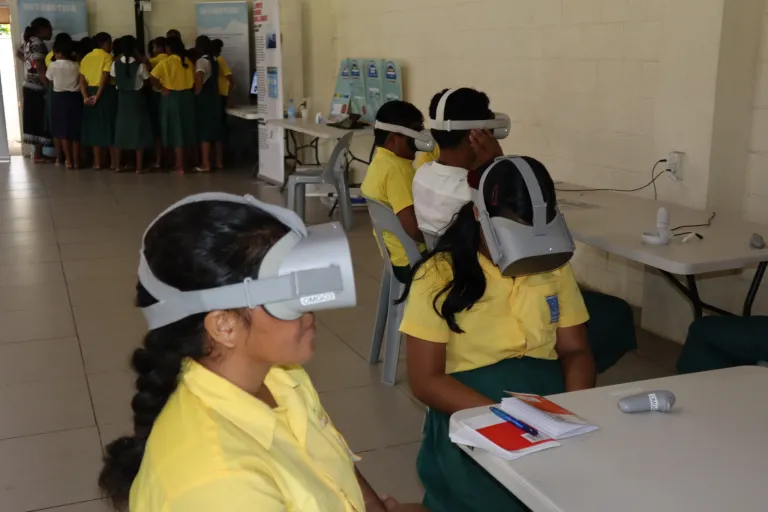
When the opportunity came to apply for AAS, she was not deterred by how different her choices were to her fellow scholars. Majority of her fellow applicants were going for policy and governance courses. Meanwhile, Jade recognised that while science communication was a broad term, it was necessary and important to her home community. She recognised the different levels of scale in science communication, and pitched the importance of that in her applications -- how a community teacher relates to a student is important and difficult, how governments relate to different demographics of peoples, how those at the forefront of agricultural innovation relate to farmers are all important and complex in different ways.
In Samoa in particular, Jade recognised that a vast majority of science was being done around agriculture and the sea, but that these same scientists and international experts always seemed to speak a different language from the community. She recounted an event that made a particular impression on her: attending a panel on flood control, where an advocate from overseas talked about how findings in Samoa had to be taken to an international level. Meanwhile, a farmer and the only locally-based member of the panel talked about grassroots action. He talked about how he and other farmers had felt a lack of government support, and had been undertaking their own projects like planting mangroves. It clicked for Jade, that sometimes you do not need governments to make a change.
"Climate advocacy makes more sense from the people on the ground, instead of experts abroad".
This fed into her wider realisations about what she calls "the big need" for experts in science communication: "Good research is nothing if hidden behind jargon or even the language not spoken ... Scientists have trouble communicating their science well. And science communicators help with this."
She wanted to be that expert for her Samoan community, through AAS getting her to CPAS at ANU.
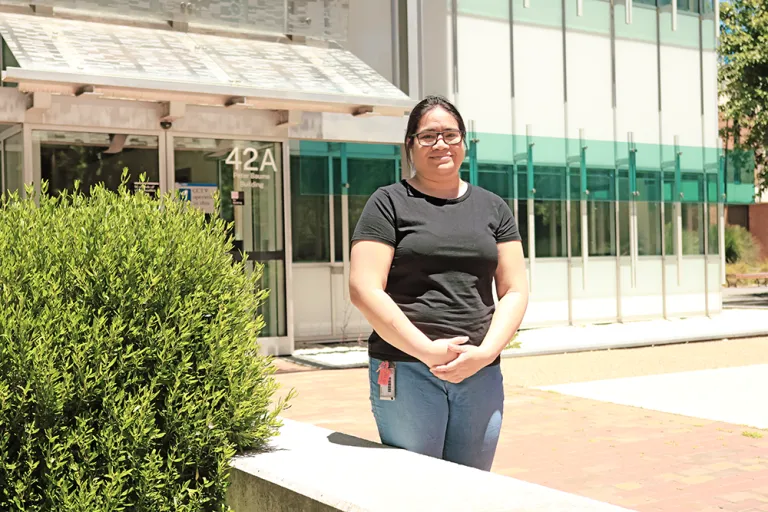
After having to take a semester online because of COVID-related lockdowns in Samoa, Jade finally got to Canberra in January 2024. She stayed at Toad Hall, a predominantly postgraduate occupied dormitory. She got along really well with her block. This was the start of Jade enjoying learning about other people's cultures and sharing her own perspective.
The AAS helped Jade massively -- without the scholarship, it would simply have been too challenging for her to come to ANU. Through their support, she was able to open her future up, meet people from all around the world, and represent her culture. She sees herself working anywhere and everywhere she is needed, bridging university education with agriculture, natural resources and environments with NGOs, policies with the youngest students in the smallest classrooms,
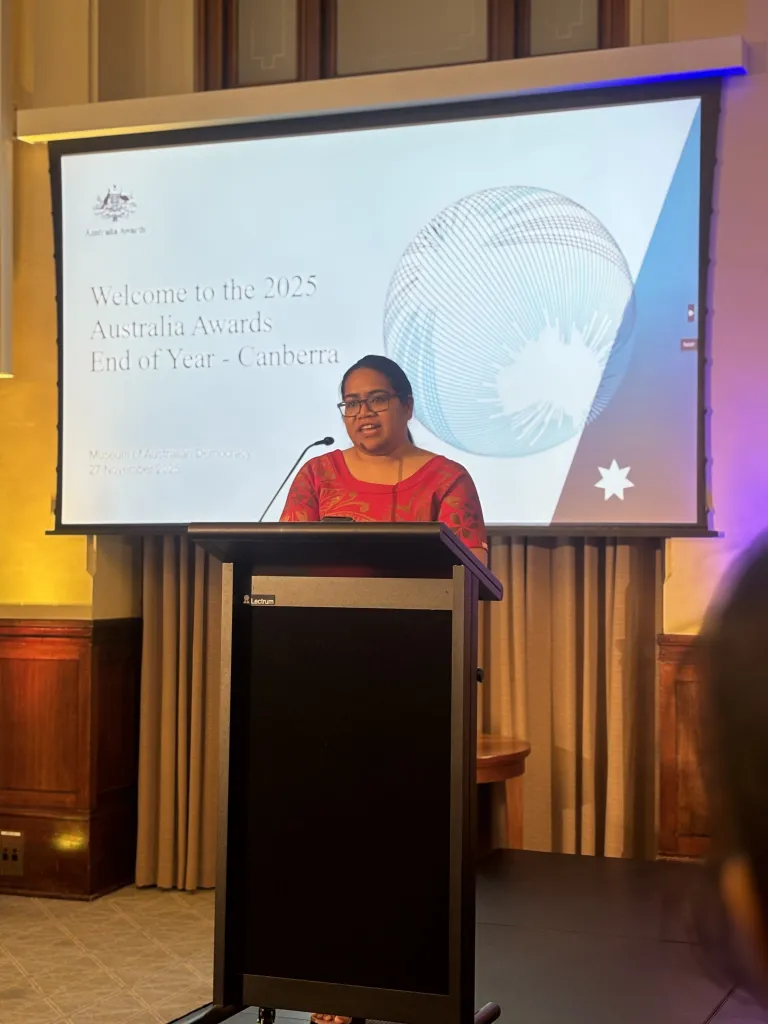
She shared her experiences, learning and being active as a science communicator in Canberra, in a speech she delivered at the AAS EOY celebration, in December 2025.
"When I reflect on my time as an Australia Awards scholar, one experience that stands out began at Questacon, where I volunteered as a science communicator. Standing in front of curious children and families, I learned how powerful storytelling can be in bringing science to life. Those moments where I was explaining complex ideas in simple, engaging ways reminded me why I first fell in love with learning. Knowledge, when shared, can spark wonder.
Later, I had the chance to work with the Questacon Deakin team on a project called Climate Connections. We used narrative storytelling to explain the science of climate change. In that show, I played the character Sina, guiding students through experiments that revealed the environmental challenges facing the Pacific. It was a deeply meaningful experience, blending science, creativity, and cultural identity to help young people understand that climate change isn’t just data; it’s a story that affects all of us, especially in our region.
That continued through one of my course projects, where I created an online English–Samoan Science Dictionary. For me, it was more than an assignment, it was a way to make science more accessible for students back home, to show that language should never be a barrier to discovery. It was a small step toward bridging worlds: English and Samoan, science and culture, local and global."
At CPAS, Jade discovered yet more facets of science communication she had not considered. She cites history of health issues and the use of science communication for military purposes as examples of fields she did not even know existed.
She connected with everyone at CPAS, who she felt were all rooting for her success. In particular, she appreciated the support of the HDR students, and being able to learn from Graham, Sujatha Raman, Rini Astuti, and Faranak Hardcastle. With Dr Matt Nurse, she recalled having great conversations around minformation and politicisation around health and policy, with her personal context around the 2019 Samoan Measles epidemic as an example.
"It was interesting hearing the information someone had about the event from the outside, sharing what I knew and experienced, and then combining that for better insights on what happened. I realised people, even Samoans, all over the world were receiving the wrong information ... It made me question, how can I talk to anti-vaxx people without being too biased myself."
Jade will be graduating in February 2026. While she will miss ANU and Canberra, Jade is excited at giving back to her community. She sees herself going into policy or teaching eventually, all while continuing to help out at Imagine Science Samoa. As she said in her speech:
"I am sure that you all have these moments in your own educational journey and that journey won’t end when we graduate or fly back. In many ways, that’s when it truly begins."
(Hear more of Jade's stories and experiences alongside her other peers at CPAS in this video):