
CSS Distinguished Speaker Series: Professor Jessica M. Smith
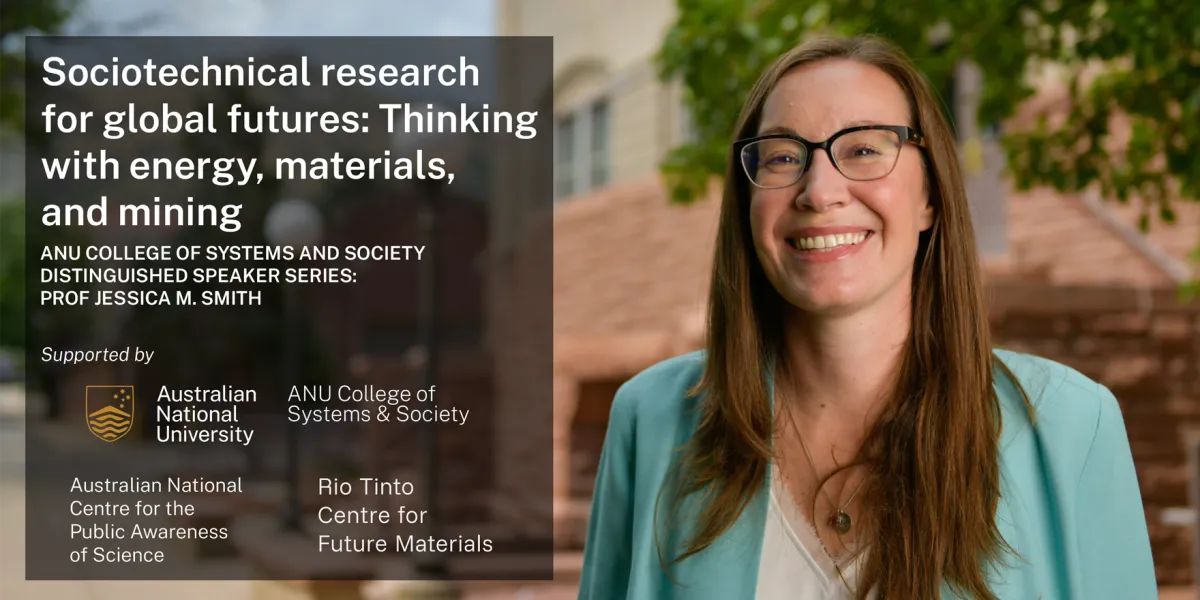
Sociotechnical research for global futures: Thinking with energy, materials, and mining
Calls for inter-and trans-disciplinary research to address our multiple planetary crises have become commonplace. Yet this kind of work is notoriously difficult, especially when it involves “far” collaborations between STEM and social science disciplines. In this talk, Professor Smith will share how sociotechnical approaches can enable transformative research, with a focus on energy, materials, and mining.
Speaker: Professor Jessica M. Smith is a global leader in theorizing and integrating the societal dimensions of technology-driven innovation, with particular expertise in energy and natural resource production. With the support of an Andrew Carnegie Fellowship, she is completing a book on political polarization and the energy transition in the American West. She is currently Dean’s Fellow of Earth and Society Programs and Professor in the Department of Engineering, Design, and Society at the Colorado School of Mines. She also serves on Rio Tinto’s Innovation Advisory Committee. Professor Smith was named a Kavli Fellow by the National Academy of Sciences in 2022 and held a British Academy International Visiting Fellowship at the University of St. Andrews in 2018.
Professor Smith is the author of two books and more than 70 peer-reviewed publications in anthropology, science and technology studies, and environmental social science journals. Her book Extracting Accountability: Engineers and Corporate Social Responsibility (MIT Press, 2021) was funded by the National Science Foundation (NSF), and her first book Undermining Gender: Rhythms of Work and Family in the American West (Rutgers University Press, 2014) was funded by the NSF and the National Endowment for the Humanities. Her recent research on carbon capture and storage has been funded by the Alfred P. Sloan Foundation and the U.S. Department of Energy. In 2016, her Corporate Social Responsibility course was named an Exemplar in Engineering Ethics by the National Academy of Engineering. She currently serves as Editor-In-Chief of the journal Engineering Studies and as a member of the U.S. National Academies’ Committee on Geological and Geotechnical Engineering. She holds a PhD in anthropology from the University of Michigan and a BA from Macalester College.
Schedule
6.00 pm Welcome
6.05 om Lecture
6.45 pm Q&A
7.00 pm Drinks and canapes served in The Gallery
Supported by
The Australian National University College of Systems and Society (CSS) uses systems-based approaches to solve modern global challenges.
We bring together critical capabilities in understanding the modern interfaces between systems, technology, processes, the physical world, and the social world.
The College creates a deep systems and society focus to support the ANU national mission. We are future-focused and equipped to prepare graduates who are ready to tackle the complexities of the future world.
The College brings together computing, cybernetics, mathematics, engineering, environment and society, and science communications.
The Australian National Centre for the Public Awareness of Science (CPAS) is the leading centre in Australia for research, education and practice in science communication and engagement.
The Centre’s mission is to encourage a confident democratic ownership of modern science nationally and internationally by increasing science awareness in the community, fostering public dialogue about science, and improving the communication skills of scientists.
CPAS was the first science communication centre in Australia. It was one of the first globally to recognise the importance of communicating science in ways that engage public audiences, including with underserved communities and young people. It was established to teach, research and conduct outreach activities in the disciplinary area of science communication. Today, CPAS is a global leader in the field, with collaborations across our region and the world.
CPAS is based in the ANU College of Systems and Society from 2025, with students drawn from all areas of science and cross-disciplinary areas of the social sciences, humanities, law and policy. It was originally based in the ANU College of Systems and Society.
As science and its relationship to society is changing in unprecedented ways, CPAS is reimagining science communication for the 21st century.
The Rio Tinto Centre for Future Materials. We are a collaboration between six world-leading partners, bringing together cutting-edge research and industry expertise. At its core are Rio Tinto, one of the world’s largest and most influential mining and materials companies and Imperial College London– a global top ten university. The Centre acts as a hub for collaboration with four other leading global institutions: The University of British Columbia, Vancouver, The University of California, Berkeley, The University of the Witwatersrand, Johannesburg and The Australian National University, Canberra.
We bring together world-class scientific research and industry expertise to drive more sustainable mining and material resource management. By integrating cutting-edge research with real-world application, we are not just responding to today’s challenges: we are setting new standards for the entire sector.
By bringing together expertise in materials, business, tech, physics, engineering, earth sciences and sustainability, this Centre is more than a research hub- it is a bold initiative to rethink how the world sources, designs and recycles materials. Together, we are shaping a future of materials with environmental, social and economic responsibility at the core.